
Your reliability programme report, built from your exports
The monthly and annual report your approved reliability programme calls for, with alert levels worked out correctly, every chapter in alert explained, and a ranked list of what to do. Your engineers stop building it by hand.
Every section, every month, in the same order
Choose any period and print an A4 landscape PDF with page numbers. Notes your engineers write on a chapter, aircraft or part type print in the right place.
- Cover, contents and sign-off
- Executive summary
- Definitions with the correct formulas
- Utilisation by month and aircraft
- Technical dispatch reliability
- Engines: UER, IFSD, EGT margin
- Pilot and maintenance reports by chapter
- Top ten actual rate
- Deferred items and DOI
- Repetitive defects
- Unscheduled removals
- Component reliability and MTBUR
- Wheels and brakes
- Delays and cancellations
- Recommendations with owner and status
- Year-by-year comparison
- One page per aircraft
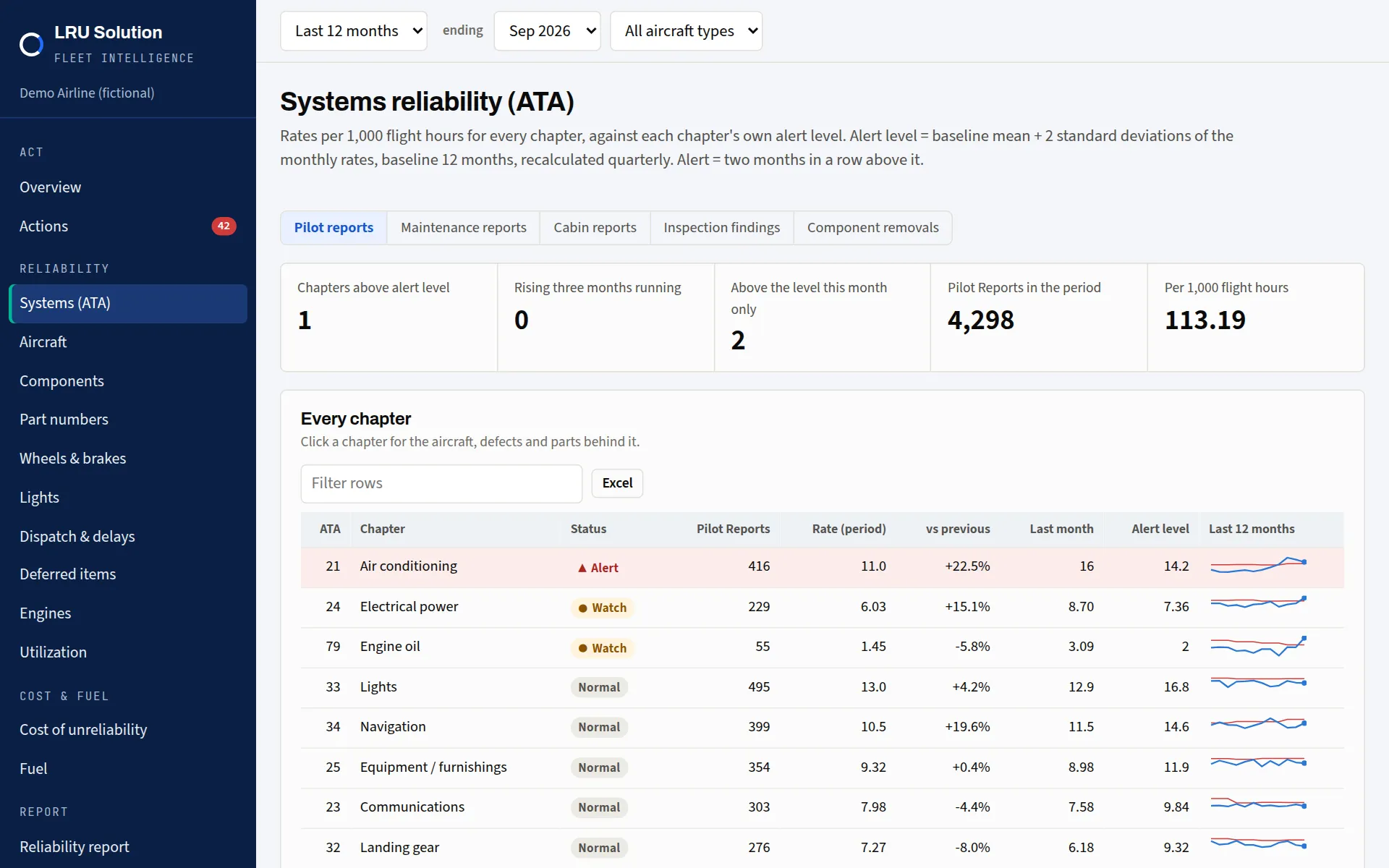
The systems view on the demo airline: fictional data, the real rules.
A chapter in alert, and the reason behind it
Rates per 1,000 flight hours for pilot reports, maintenance reports, cabin reports, inspection findings and unscheduled removals, each against its own alert level.
Your programme's own rules
Mean plus k standard deviations, or a Poisson limit for rare events; your baseline length, your recalculation interval and your alert rule. Each chapter shows Alert, Rising, Watch, Cleared or Normal.
One aircraft or the whole fleet?
Every aircraft is compared with its flight-hour share in each chapter, with a statistical test so one busy month doesn't raise a false flag. The automatic note names the main reason in your engineers' own pattern.
Fixes that didn't hold
The same fault on the same aircraft, three times in 15 days by default, matched on the ATA 4-digit or the wording, with fixes that were only resets, checks or swaps called out.
Everything the programme looks at
Dispatch and delays
Technical dispatch reliability against your target, delays per 100 departures, mean technical delay, delay minutes by chapter and cause, and every technical delay. Schedule reliability for all causes is shown apart and named as such.
Deferred items
Deferrals per 100 cycles by chapter, DOI defined and calculated, open MEL items with due dates from their category, overdue and due-soon flags, and items deferred again and again.
Engines
Unscheduled engine removals and in-flight shutdowns per 1,000 engine hours with an alert level, and the EGT margin trend for each engine serial with the months left to its limit.
Each aircraft
Every aircraft against its type fleet, with a one-page view: daily flight hours with check and AOG bands, write-ups by chapter, component changes, open deferred items, wheel and brake changes, and its actions and notes.
What we fixed in the reports we studied
We built the report from real airline reliability reports, page by page, and corrected what they got wrong.
A true total rate
The legacy "grand total rate" was an average of chapter rates. The report shows the real total.
Rotables no longer hidden
Wear items such as wheels, tyres, brakes and lamps dominated the "top ten removals". Rotables and wear items are now ranked apart.
Wheel and brake figures pooled correctly
Mean time between removals is total hours times quantity divided by removals, not the average of monthly values.
DOI defined
Open deferred items per aircraft per day, calculated from the records, with the legacy printed value shown beside it.
What it found this year
A fictional airline with 14 aircraft, run through the real rules.
One chapter in alert, two on watch
Air conditioning pilot reports at 16.0 per 1,000 FH against an alert level of 14.21.
One aircraft carrying the problem
LR-ABC: 85 air-conditioning defects in 12 months where about 50.7 were expected for its flight hours.
A fix that didn't hold
LR-ABE: the same ATA 21-51 fault 39 times in 90 days, mostly reset or checked rather than repaired.
Dispatch below target
98.68% against 99.0%, with the chapters causing the most delay minutes listed first.
Start with four files
Your aircraft list, utilisation, technical log and component removals give you the systems view, repetitive defects, deferred items and the report. Delays and engine data add dispatch and engines. Six months of history gives the first alert levels.
Fleet Intelligence is a screening and reporting aid. It supports your approved reliability programme and doesn't replace it, or the judgement of your certifying staff.